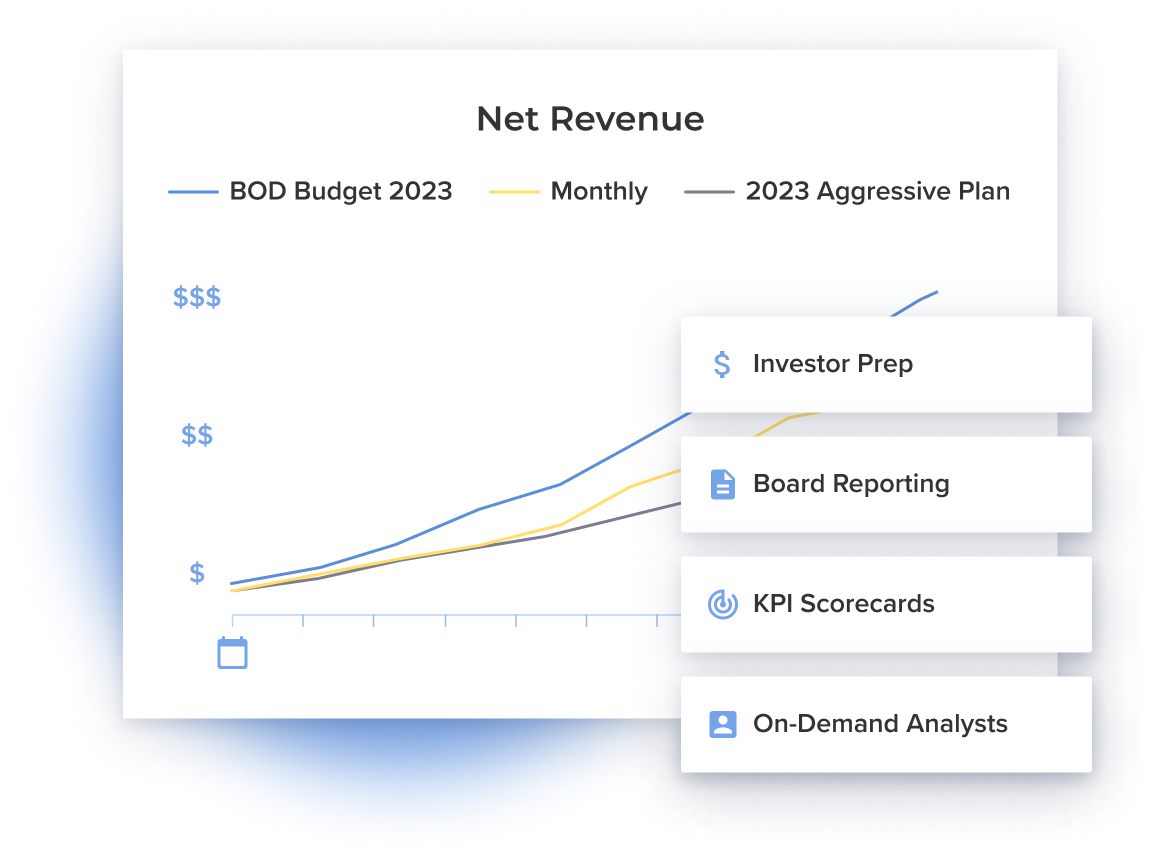
This guide covers what scenario modeling is, why consumer brands use it to protect profitability, and how to build scenarios that turn uncertainty into actionable plans for inventory, pricing, and channel decisions.
Key takeaways
- Scenario modeling creates multiple "what-if" financial projections to test how different market conditions affect profitability and cash flow before committing capital to inventory or channel expansion.
- Consumer brands face unique risks from physical inventory investments, with returns projected to reach $849.9 billion in 2025, making scenario planning critical for protecting margins from overstock markdowns and stockout losses.
- Effective scenario models focus on 5-8 high-impact variables like sell-through rates, unit economics, wholesale chargebacks, marketing spend efficiency, and channel-specific performance metrics rather than trying to model every possible outcome.
- Real-time data integration from platforms like Shopify, Amazon, and retail partners eliminates manual updates and keeps scenario models grounded in current performance rather than outdated assumptions.
What is scenario modeling for consumer brands
Scenario modeling is a planning method that lets you test how different future conditions affect your profitability and cash flow before you spend money on inventory, marketing, or new channels.
You build multiple "what-if" versions of your financial future to test how different conditions affect your business. Instead of predicting one outcome, you create several plausible scenarios (like an economic downturn, a supply chain hiccup, or a competitor slashing prices) and see how each one impacts your margin and cash position before you commit capital to inventory or expansion.
Think of it as financial stress-testing. You're not trying to predict exactly what will happen. You're preparing for a range of possibilities so you can make smarter decisions about purchase orders, marketing spend, and retail partnerships.
Key differences from traditional budgeting
Traditional budgeting assumes one set of numbers and builds a single plan for the year. Scenario modeling acknowledges that the future is uncertain, so it creates multiple versions of your financial plan, each based on different assumptions about demand, costs, and market conditions. While a budget tells you where you plan to go, scenarios show you how to adapt when reality looks different.
Scenario modeling vs scenario analysis vs forecasting
In practice, scenario modeling, scenario planning, and scenario analysis are closely related approaches that often overlap. Many finance teams use these terms interchangeably. The key difference is emphasis:
- Scenario modeling (this guide's focus) emphasizes the technical process of building multiple financial projections with different assumptions
- Scenario planning emphasizes the strategic process of preparing for different futures and deciding how to respond
- Scenario analysis emphasizes evaluating those scenarios to identify risks, opportunities, and key decision triggers
Think of them as different lenses on the same practice: creating multiple financial futures to make better decisions under uncertainty. This guide focuses on the modeling mechanics—how to actually build the scenarios consumer brands need.
Related: Financial Scenario Analysis for Consumer Brand Growth
Why consumer brands need scenario modelling to protect margin and cash
Consumer brands face financial pressures that make scenario modeling essential. Physical products tie up cash in inventory, and getting those bets wrong can hurt even profitable brands. With returns projected to reach $849.9 billion in 2025, every inventory decision carries real risk. Overstock leads to markdowns that erode margin, while stockouts mean lost sales you can't recover.
Large SKU counts and inventory risk
When you manage hundreds or thousands of SKUs across multiple channels, each product represents cash you're spending before you've sold anything. A furniture brand might carry 200 SKUs with six-month lead times, while an apparel company manages 2,000 styles across seasonal collections. Scenario modeling helps you test different demand outcomes for each product category before you lock in production quantities, protecting you from both stockouts that lose sales and overstock that kills margins through markdowns.
Channel-mix volatility
DTC sales might deliver 60% gross margins with immediate payment, while wholesale to Target operates at 40% margins with 90-day payment terms. Shifting just 20% of your revenue mix from DTC to wholesale changes both your margin profile and your working capital requirements. Scenario modeling quantifies the tradeoffs before you commit to channel expansion.
Capital-intense purchase orders
When a major retailer offers you shelf space, you're often committing to six-figure purchase orders months before you'll see revenue. One beauty brand we work with faced a $400,000 inventory commitment for a Walmart launch with uncertain sell-through rates. By modeling optimistic, realistic, and pessimistic scenarios for velocity and chargebacks, they sized their initial order to protect cash while still capturing the opportunity.
Core drivers and data sources every brand should model
Effective scenario modeling depends on identifying which variables actually move the needle on margin and cash. Consumer brands typically focus on five areas.
Sell-thru and return rates
Channel-specific performance metrics directly determine how quickly inventory converts to cash. An 8% weekly sell-through rate at Target versus 12% changes your reorder timing, markdown risk, and cash conversion cycle. Returns vary even more dramatically. DTC apparel might see 30% return rates while grocery products return under 2%.
Unit economics and COGS inputs
Material costs, labor rates, and shipping expenses affect gross margins under different volume scenarios. When cotton prices spike 40% or container rates triple, your margin structure changes. Higher volumes don't always improve profitability if input costs are rising faster than your ability to raise prices.
Wholesale chargebacks and deductions
Retailer-specific fees, markdowns, and penalties reduce net revenue in ways that don't show up in your initial PO. Walmart might take 3% for freight, 2% for marketing support, and another 5% for end-of-season markdowns, turning a 40% wholesale margin into 30% after all deductions.
Marketing spend and CAC
Customer acquisition costs determine whether DTC growth is profitable or just expensive. If your blended CAC is $45 and average order value is $85 with 50% gross margins, you're making $42.50 per order minus $45 in acquisition cost (losing money on first purchase). Scenario modeling tests different CAC levels, repeat rates, and lifetime value assumptions to find the marketing spend level that actually drives profitable growth.
Direct integrations like Shopify and Amazon
Real-time data feeds from eCommerce platforms, retail channels like Target and Walmart, and accounting systems like QuickBooks eliminate manual data entry and keep your scenarios grounded in actual performance. When your model pulls yesterday's sales and today's inventory levels automatically, you're making decisions based on current reality rather than last month's spreadsheet.
Step-by-step guide to building a scenario model
Building your first scenario model feels overwhelming, but breaking it into steps makes the process manageable.
1. Define the decision and time horizon
Start with a specific decision that requires scenario planning, like whether to accept a $300,000 Target PO, launch a new product line, or expand into wholesale. Your time horizon depends on the decision: inventory commitments might require 6-12 month scenarios, while fundraising or retail expansion might need 24-36 month projections.
2. Identify uncertain drivers
Focus on variables with both high impact and high uncertainty. Consumer demand, input costs, and competitive pricing typically qualify. They significantly affect your results and you can't predict them with confidence. List 5-8 key drivers, since modeling too many variables creates complexity without adding insight.
3. Build assumptions and ranges
For each driver, create optimistic, realistic, and pessimistic ranges based on historical data and market research. If your DTC conversion rate has ranged from 2.1% to 3.4% over the past two years, those become your bounds. Consider outcomes outside your recent experience. Supply chain disruptions and economic shocks can push variables beyond historical ranges.
4. Connect data and automate feeds
Link your model to Shopify, Amazon, QuickBooks, and retail partner systems so scenarios update with real performance data. Manual models decay quickly because updating them takes hours, causing teams to make decisions on stale assumptions.
5. Run scenarios and compare outcomes
Generate financial projections across your scenarios, focusing on the metrics that matter for your decision (typically cash flow, gross margin, and inventory turns for consumer brands). A quick comparison helps stakeholders grasp the range of possibilities:
- Optimistic scenario: Revenue hits $8.2M with 58% gross margin, leaving you with $1.4M in cash. This represents your best-case outcome where demand exceeds expectations and costs stay controlled.
- Realistic scenario: Revenue lands at $6.7M with 52% gross margin and $890K cash position. This middle path reflects what's most likely to happen based on current trends and historical performance.
- Pessimistic scenario: Revenue drops to $4.9M with 47% gross margin, bringing your cash position down to $320K. This stress-test shows how your business performs when multiple factors move against you simultaneously.
Laying out these three scenarios side-by-side immediately shows whether your cash position remains healthy across all outcomes or if pessimistic scenarios create existential risk that requires contingency planning.
6. Present insights to stakeholders
Board-ready summaries highlight key risks, opportunities, and recommended actions rather than overwhelming leadership with model details. Focus on decision points: "Under realistic assumptions, the Target launch generates $240K in incremental profit with manageable cash requirements. However, if sell-through falls below 6% weekly, we'll need an additional $150K in working capital."
Economic scenario modeling for demand and inventory shocks
Macro uncertainty affects consumer spending in ways that ripple through your entire financial model.
Macro drivers to stress-test
Consumer brands typically model three economic scenarios: continued growth, mild recession, and severe downturn. Each scenario changes consumer spending patterns differently. Premium products see sharper demand drops than value offerings, while consumables prove more resilient than discretionary purchases. A home goods brand might model 15% revenue decline in mild recession and 30% in severe downturn, while a food brand might see 5% and 12% respectively.
Merchandising-specific scenarios like markdown waves
Seasonal clearance, competitive pricing pressure, and inventory liquidation create margin compression that compounds during economic uncertainty. When a competitor drops prices 25% to clear excess inventory, you face a choice: match their pricing and protect volume while sacrificing margin, or hold pricing and accept volume loss. Scenario modeling quantifies both paths.
Related: Inventory Planning Methods for Modern Consumer Brands
Software or spreadsheet: how to choose the right tool
Every finance team eventually faces this question: when does Excel stop being sufficient?
Complexity and scale thresholds
Spreadsheet-based scenario modeling works reasonably well for brands with under 50 SKUs, 1-2 sales channels, and straightforward cost structures. Once you cross 100+ SKUs, add wholesale partnerships, or start managing multiple retail channels with different terms and chargebacks, spreadsheet models become brittle and error-prone. If you're spending more than 10 hours per month maintaining your scenario model, you've likely crossed the threshold where a finance platform delivers ROI.
Total cost of ownership
Compare spreadsheet maintenance costs (the fully-loaded hours your team spends building, updating, and fixing models) against finance platform subscription and implementation costs. A finance director earning $120K annually who spends 15 hours monthly on spreadsheet maintenance represents $10,800 in annual cost, not including opportunity cost of strategic work they're not doing.
Integration and collaboration needs
Real-time data requirements, multi-user access, and audit trail capabilities often tip the scales toward purpose-built platforms. When your CEO, CFO, and head of operations all need to review scenarios simultaneously, spreadsheet version control becomes nightmarish.
Real-world examples of scenario forecasting in retail and merchandising
Concrete scenarios help illustrate how consumer brands use modeling to protect margin and cash.
Promo price drop vs margin tradeoff
A beverage brand considered dropping their DTC price from $36 to $29 per case to drive volume during a slow quarter. Scenario modeling revealed that even if the promotion lifted volume 40%, the margin compression from $18 to $14.50 per case meant they'd earn less total gross profit: $174K versus $180K at baseline. They skipped the promotion and focused on higher-margin channels instead.
PO delay impact on stockouts
An apparel company faced a four-week production delay on their fall collection due to factory closures. By modeling different delay scenarios and their sell-through implications, they identified which SKUs to air freight versus accept stockouts. The analysis showed that air freighting their top 12 SKUs cost $28K but preserved $180K in margin from avoided stockouts, while their long-tail SKUs didn't justify the freight premium.
New channel launch cash requirements
A beauty brand received a Ulta opportunity requiring $250K in initial inventory with 75-day payment terms. Scenario modeling across different sell-through rates revealed they'd need an additional $80K in working capital during months 2-4 to maintain their DTC inventory levels while waiting for Ulta payment. This insight let them secure a line of credit before launching rather than discovering the cash gap mid-launch.
Best practices to keep models accurate and board-ready
Building your first scenario model is just the beginning. Maintaining accuracy and relevance requires ongoing discipline.
Version control and audit trails
Track assumption changes and scenario evolution over time so you can learn from past projections. When your realistic scenario predicted $6.7M in revenue but you actually delivered $7.2M, understanding which assumptions were wrong improves future models.
Sensitivity vs probability weighting
Focus on impact magnitude rather than trying to assign precise probabilities to each scenario. A 15% chance of severe recession might sound scientific, but probability estimates are often just guesses dressed up as analysis. Instead, understand which variables have the largest impact on your key metrics.
Monthly iteration cadence
Regular model updates with actual results create a continuous refinement loop that improves accuracy over time. Each month, compare your scenarios to actual performance, update assumptions based on new information, and regenerate projections for the remaining planning period.
From what-if to what-now: turning scenarios into action with Drivepoint
Scenario modeling delivers value when it drives better decisions, not when it produces prettier spreadsheets.
Align financial demand and inventory plans
Connect scenario outcomes to operational decisions by linking financial projections to physical inventory requirements and cash flow timing. When your realistic scenario shows $6.7M in revenue, your demand plan translates that into SKU-level production quantities, and your cash flow model shows exactly when you'll need working capital to fund purchases.
Book a demo to see Drivepoint in action
Drivepoint is built specifically for consumer brands managing the complexity of physical inventory, multiple SKUs, and retail channel partnerships. With direct integrations to Shopify, Amazon, Target, Walmart, and many more retail channels and eCommerce platforms, Drivepoint eliminates manual data entry and keeps your scenario models grounded in real-time performance. Book a demo to see how embedded analysts and purpose-built scenario modeling capabilities help consumer brands protect margin and cash.