Every morning, millions of people start their day with a protein-packed breakfast from Oats Overnight. But behind that simple customer experience is a complex strategic question that founder Brian Tate faced: when exactly should they expand production capacity to maximize financial return?
The answer to that question was worth $4 million in EBITDA.
The Contrarian Bet That Created a Capacity Problem
Brian Tate made an unconventional choice when building Oats Overnight. While most CPG brands outsource manufacturing to co-packers, Tate insisted on in-house production. For a clean-protein product where quality is everything, controlling the manufacturing process wasn't optional. It was essential to delivering the product customers expected.
The bet paid off spectacularly. Orders flooded in through both DTC and wholesale channels. Oats Overnight became a household name for health-conscious consumers looking for convenient, nutritious breakfast options.
But success created its own challenge. Demand was outpacing production capacity. To keep customers happy and capitalize on growth momentum, Oats Overnight needed to expand their facilities. The stakes were high: they'd be investing significant capital in new production capacity with permanent cost implications.
The question keeping Tate up at night wasn't whether to expand; it was when. Get the timing right, and they'd capture revenue at the perfect moment while managing costs efficiently. Get it wrong, and they'd either miss a massive sales opportunity or saddle the business with excess capacity and unnecessary expenses.
When Conventional Analysis Tells Half the Story
When the Oats Overnight team initially modeled the facility expansion decision, the answer seemed clear: wait a few months. Delaying the investment appeared more cost-efficient on the surface. Why accelerate expenses if you could postpone them?
This is where most consumer brands make critical strategic mistakes. They look at the cost side of the equation in isolation, asking "how do we minimize expenses?" rather than "how do we maximize value?" They optimize for the wrong variable.
The problem with this approach is that it ignores the opportunity cost of waiting. What revenue are you leaving on the table? What market momentum are you losing? What happens when demand exceeds supply during your peak selling season?
Oats Overnight needed to see the complete financial picture: not just when costs would hit, but when revenue opportunities would peak, how margins would evolve, and what the net impact would be across different timing scenarios. They needed to model the full P&L, cash flow, and capacity utilization implications of expanding now versus later.
That's exactly the kind of strategic scenario planning that's impossible to do quickly in spreadsheets—but critical for making confident capital allocation decisions.
The Complete Picture Changes Everything
After implementing Drivepoint, Oats Overnight could suddenly see what they'd been missing. The platform's strategic financial modeling revealed the complete story, not just the expense timeline.
Yes, expanding facilities sooner meant accelerating certain costs. But Drivepoint's forecasts showed something more important: expanding production capacity immediately would allow Oats Overnight to fully capitalize on the annual Q4 surge in demand. With increased capacity in place before the holiday season, they could blow past their sales targets and capture revenue that would otherwise be lost to stockouts.
The Drivepoint model made the trade-off crystal clear. The team could see exactly how and when the facility investment would pay for itself. More crucially, they could quantify the benefit of moving fast versus waiting. The answer wasn't even close.
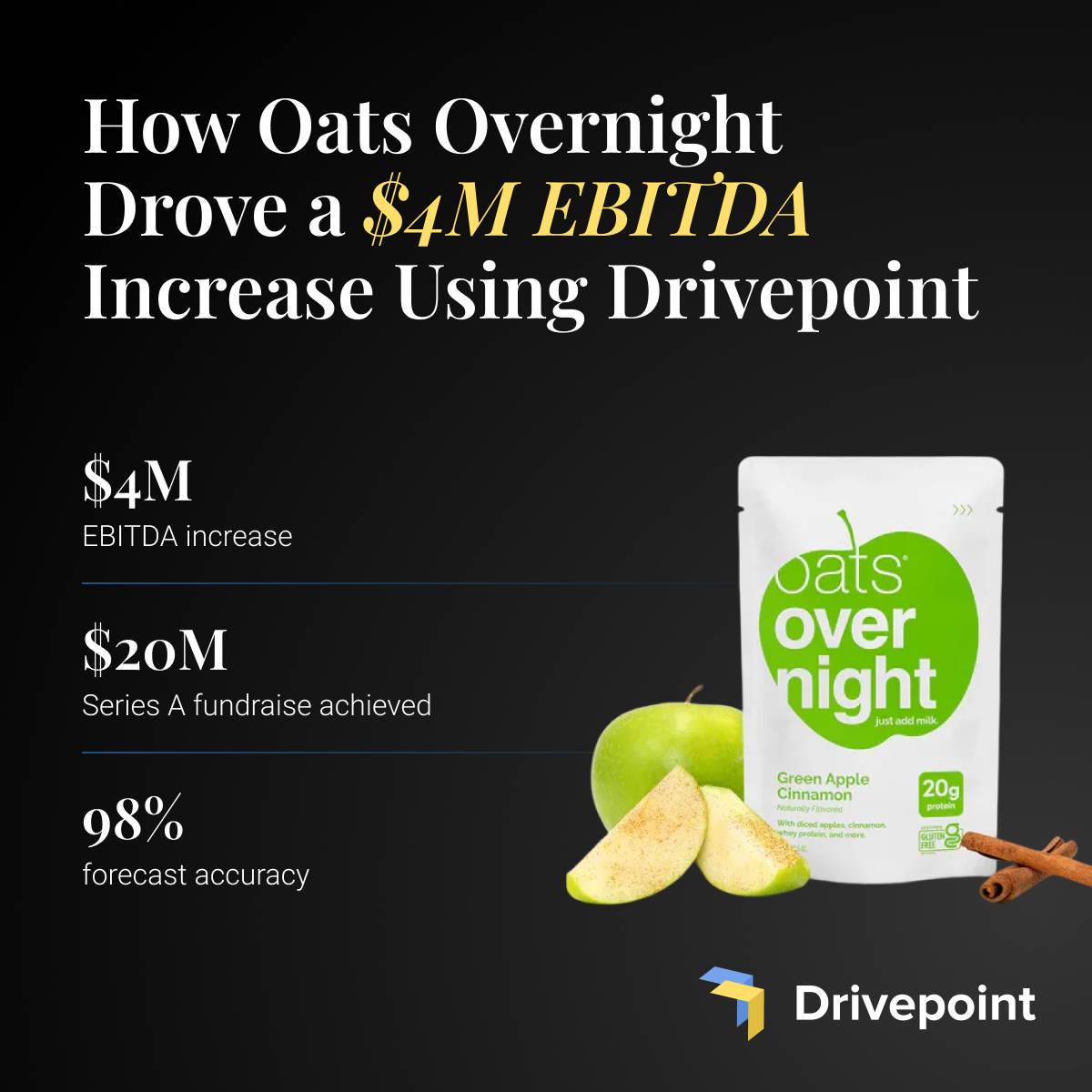
By expanding facilities ahead of Q4 rather than delaying, Oats Overnight stood to realize a $4 million EBITDA increase compared to their original budget plan. The incremental revenue from capturing peak demand didn't just offset the cost of accelerating the expansion—it dramatically exceeded it.
This is the power of complete scenario modeling. The same decision that looked expensive when viewed through a cost lens became obviously correct when viewed through a value lens. Oats Overnight wasn't just avoiding unnecessary expenses by waiting—they were leaving $4 million on the table.
Making the Call With Confidence
Armed with Drivepoint's forecasts, Oats Overnight made the decision to accelerate their facility expansion. They invested in new production capacity and scaled operations just in time to meet Q4 demand.
The results validated the model. Oats Overnight's margins surged during the holiday season, more than offsetting the added expenses of moving faster. They captured the revenue opportunity that conventional analysis would have caused them to miss. The facility investment paid for itself faster than originally projected.
But perhaps more importantly, the team made this high-stakes capital allocation decision with complete confidence. They weren't guessing or hoping. They'd modeled the scenarios, understood the trade-offs, and knew the financial implications before committing the capital. That's what strategic finance looks like.
The Compounding Benefits of Better Decisions
The facility expansion decision was just the beginning. Since implementing Drivepoint, Oats Overnight has achieved 98% forecast accuracy—a level of precision that enables better planning across every function. That accuracy helped them secure a $20 million Series A fundraise, demonstrating to investors that the business was built on solid financial fundamentals, not hopeful projections.
More fundamentally, Oats Overnight transformed how they make strategic decisions. They moved from reactive planning based on gut feel to proactive scenario modeling based on data. When major opportunities or challenges arise, they can model the financial impact immediately rather than spending days building one-off analyses while the opportunity window closes.
As Tate reflected on the transformation: "The Drivepoint model clearly demonstrated how and when the investment would be recouped—and, more crucially, the benefits of moving ASAP. Oats Overnight ultimately made the right decision and is now on pace to realize a $4 million EBITDA lift versus the budget plan."
Why This Story Matters for Every Consumer Brand
The Oats Overnight facility expansion decision illustrates why finance has become the most important function in consumer brands. This wasn't an accounting question or a bookkeeping exercise. It was a strategic decision with multi-million dollar implications that required understanding the complete financial picture across multiple scenarios.
How many consumer brands are making similar decisions right now with incomplete information? How many are optimizing for the wrong variable because they can't model scenarios fast enough? How many are leaving millions on the table because their finance function can't answer "what if" questions before the opportunity expires?
The conventional approach—spending weeks in spreadsheets trying to model scenarios manually, or worse, making gut-feel decisions without rigorous analysis—simply can't compete with the speed and precision that modern FP&A platforms enable.
Consumer brands that build this capability early gain decisive advantages. They make better capital allocation decisions. They time strategic investments more precisely. They capture opportunities competitors miss. They build credibility with boards and investors through forecast accuracy. Ultimately, they build more valuable businesses because they're making consistently better strategic decisions.
The Right Tools for Strategic Decisions
Oats Overnight's story demonstrates what becomes possible when consumer brands invest in purpose-built FP&A technology rather than trying to scale manual spreadsheet processes. The platform gave them several capabilities that made the difference:
Complete scenario modeling: Not just "what does this cost?" but "what's the complete P&L, cash flow, and margin impact across different timing scenarios?" The ability to compare multiple paths side-by-side and see the full financial picture.
Speed that matches decision timelines: Building the facility expansion model took hours, not weeks. That meant they could evaluate the decision while the window was still open, not after the opportunity had passed.
Forecast accuracy that enables confidence: When your forecasts are 98% accurate, you can trust them for major capital decisions. When they're consistently wrong, you're flying blind no matter how sophisticated your model looks.
Integration with business reality: The model pulled actual demand data, production capacity constraints, and cost structures automatically. It reflected the real business, not a simplified approximation.
This is what modern strategic finance looks like for consumer brands. Small teams using purpose-built technology to answer complex strategic questions with precision. Not armies of analysts maintaining spreadsheets, but strategic operators with tools that match the complexity of retail operations.
Building Finance as a Strategic Weapon
Oats Overnight is now using Drivepoint's detailed forecasts to plan their next phase of scaling production. They're not just reacting to demand—they're proactively modeling growth scenarios and timing investments for maximum return.
This is the competitive advantage that consumer brands can build through world-class finance capabilities. While competitors are still arguing over whose spreadsheet is right or making major decisions based on incomplete analysis, you're modeling scenarios in real-time and capturing opportunities others miss.
The $4 million EBITDA increase from one decision is impressive. But the compounding value of making consistently better strategic decisions—investment timing, pricing, channel allocation, inventory planning, cash management—is what transforms finance from a cost center into a competitive weapon.
For consumer brands at any stage of growth, the lesson from Oats Overnight is clear: the quality of your strategic decisions is limited by the quality of your financial modeling. And in 2025, the technology exists to give even lean teams enterprise-grade scenario planning capabilities.
The question is whether you'll build this capability before your next major strategic decision—or whether you'll be leaving your own $4 million opportunity on the table.